

The November - December 2025 issue of C&R Magazine highlights a critical industry reality: Payment timelines for restoration contractors remain inconsistent, opaque, and often painfully slow. The article’s graphic table reflects the norm across the industry—elongated payment cycles that create structural friction for both contractors and carriers.
At HOMEE, we believe this is one of the most underestimated levers of performance in the entire claims and restoration ecosystem.
Fast Payments Aren’t a Perk—They Are Infrastructure
While the industry still frames “speed to pay” as a downstream operational metric, HOMEE treats it as a core piece of claims infrastructure. In a sector where delays compound at every phase of a claim, reducing contractor payment lag is one of the few interventions that simultaneously improves:
- Cycle time
- Contractor acceptance rates
- Job start velocity
- Customer satisfaction
- Carrier indemnity leakage
The data in the article underscores just how wide the industry gap has become. But where traditional networks may take weeks—and in many cases, months—to release funds, HOMEE’s AI-enabled managed repair platform consistently pays contractors in a fraction of the industry-reported timelines.
Why HOMEE Pays Faster—And Why It Matters
HOMEE’s network is built around a simple promise: When contractors do the work, they get paid—fast. Often within 72 hours, not 30–90+ days.
This speed is possible because HOMEE eliminates the friction points that slow legacy networks down:
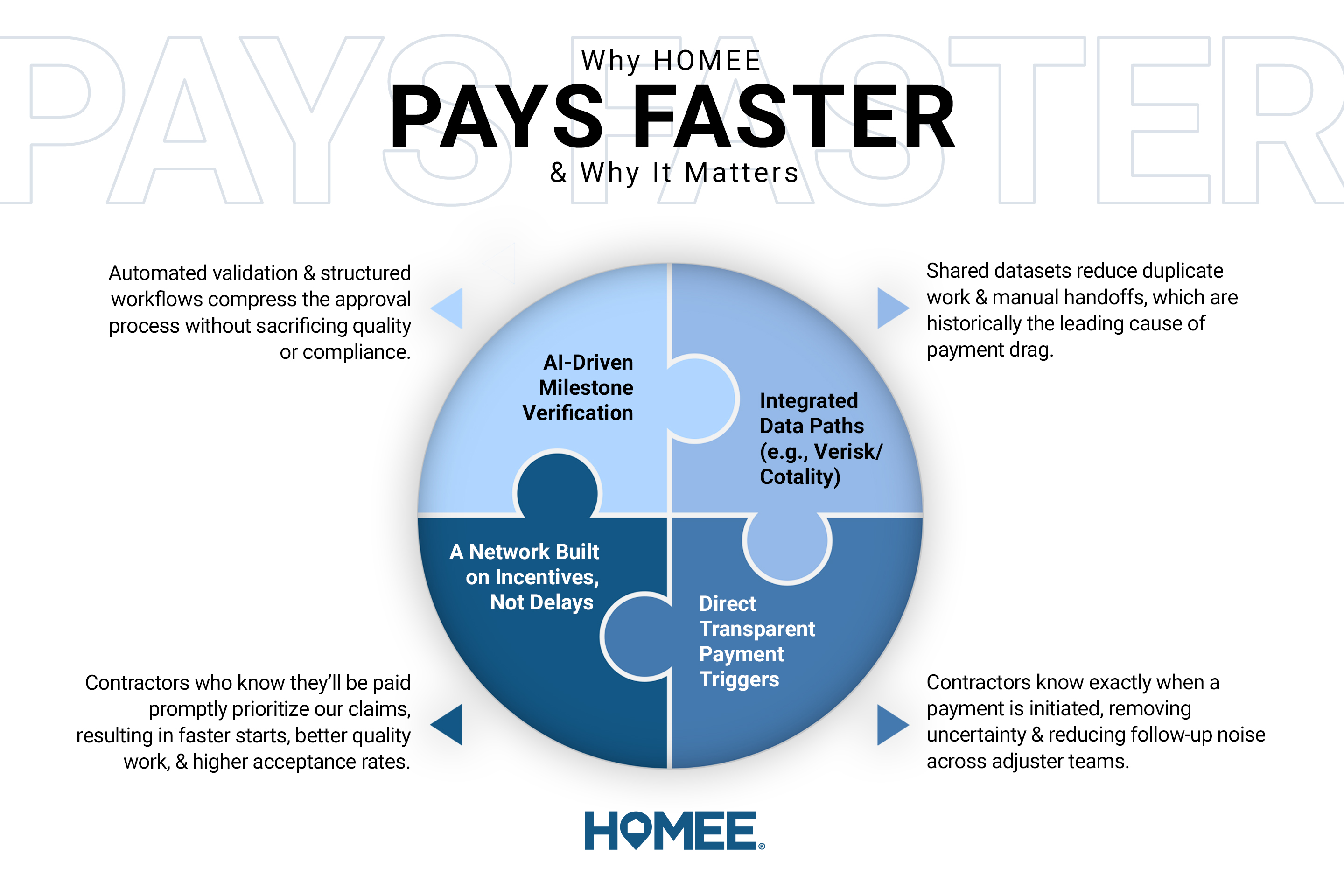
- AI-Driven Milestone Verification: Automated validation and structured workflows compress the approval process without sacrificing quality or compliance.
- Integrated Data Paths (e.g., Verisk, Cotality): Shared datasets reduce duplicate work and manual handoffs, which are historically the leading cause of payment drag.
- Direct Transparent Payment Triggers: Contractors know exactly when a payment is initiated, removing uncertainty and reducing follow-up noise across adjuster teams.
- A Network Built on Incentives, Not Delays: Contractors who know they’ll be paid promptly prioritize HOMEE claims—resulting in faster starts, better quality work, and higher acceptance rates.
The Strategic Impact for Carriers
Speed to pay has far broader implications than cash-flow morale. It drives measurable carrier outcomes:
- Faster job initiation → shorter overall cycle times
- Higher contractor engagement → higher acceptance + completion rates
- Lower job abandonment → reduced indemnity exposure
- Better policyholder experience → higher NPS + retention
Contractors want to work where they are treated like partners, not payment chasers. HOMEE’s approach changes the dynamic from adversarial to aligned.
A Different Model, Not Just a Faster One
C&R Magazine points to increasing recognition that the industry must modernize. But modernization isn’t only about AI, dashboards, or digital FNOL. It’s about building predictable, trustworthy ecosystems where every stakeholder—carrier, contractor, and customer—benefits from clarity and speed.
HOMEE’s accelerated contractor payment model is not an operational convenience; it is a strategic differentiator rooted in structured processes, technology, and transparency.
As carriers reevaluate their managed repair strategies for 2026 and beyond, time-to-pay will continue to emerge as one of the most powerful predictors of network performance.
And, on this metric, HOMEE is not just improving the baseline—we’re redefining it.
Learn more about joining HOMEE’s Pro network.